Truck GPS vs Regular GPS: What Is the Difference?
A regular GPS app is built for passenger cars. It looks for the fastest or shortest route and assumes every road is open to every vehicle. A truck is not a car, and that assumption is where problems start.
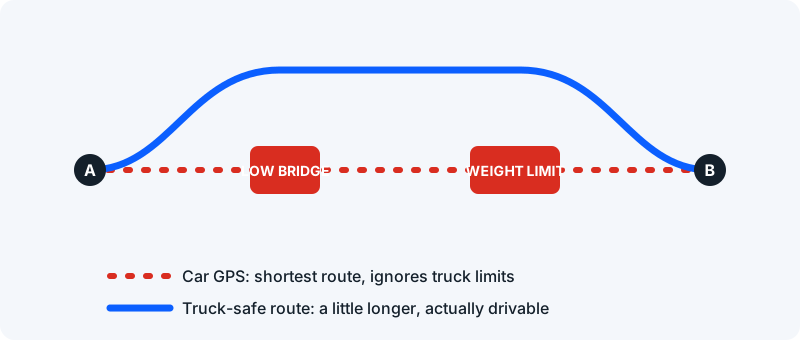
What a car GPS does not know
- Vehicle height. A common legal height limit is around 13 ft 6 in, but low bridges and tunnels sit well below that and are not always signed early enough to stop.
- Weight. Many local roads and bridges post weight limits that a loaded truck cannot use.
- Length and turning radius. A route with tight turns can be fine for a van and impossible for a tractor-trailer.
- Truck-prohibited roads. Some streets and parkways ban commercial vehicles outright.
What truck-specific navigation adds
Truck navigation lets you enter the vehicle's dimensions and weight, then routes around roads that do not allow it. Better products also account for truck-preferred routes and give lane and turn guidance suited to large vehicles.
Why it matters more for a fleet
With one owner-operator, you learn your own routes. With three or more trucks, you have drivers on unfamiliar roads every day. One wrong route can mean a detour, a fine, a damaged trailer, or a stuck truck blocking traffic. A single fleet-wide tool gives every driver the same restrictions data without each person buying their own app.
Running 3 or more trucks?
Trucker Path offers a discounted fleet navigation plan (TP Fleet Nav) for fleets of 3+ trucks. We can introduce you to their team.
Get a free introductionDisclosure: This site is independent and is not Trucker Path. We may earn a commission if a company we introduce becomes a Trucker Path customer. This does not change what you pay.