How to Avoid Low Bridge Strikes: A Practical Guide for Fleets
A bridge strike is rarely about a driver who cannot drive. It is usually a gap: the route was planned for a car, the height in someone's head was out of date, or a detour was taken at the last minute. A small fleet can close most of those gaps without buying anything complicated.
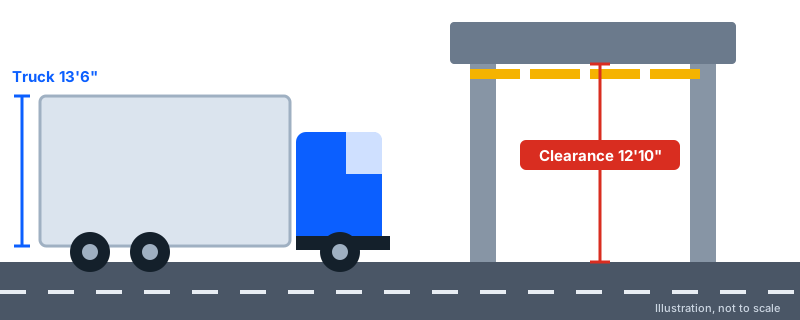
Where strikes actually come from
- A car or phone map app chose the route. General map apps are built for cars and do not know your truck's height. See truck GPS vs regular GPS.
- The remembered height is wrong. A different trailer, a reefer unit, a roof fairing or a tall load changes the real height.
- The driver left the planned route. Missed exits, closures and fuel or parking stops push drivers onto roads nobody checked.
- Unfamiliar local roads. Older urban areas tend to have more low clearances, and the last mile to a shipper or receiver is often where the risk is.
Step 1: Know the real height of every rig
Measure the truck as it actually runs, with the trailer and any equipment on top, and write the number down. If a load can change the height, record the tallest case. Re-measure when the trailer or equipment changes. A figure copied from a spec sheet is a starting point, not a measurement.
Many standard 53-foot dry vans are about 13 feet 6 inches, but that is a typical figure, not your truck's. A heavy load can compress the suspension, tire size and pressure shift the height, and an air-ride trailer can be raised or lowered, so the driver may not be working from the right number.
- Make checking the height part of the pre-trip inspection.
- Post the height where the driver can see it in the cab, especially in leased or shared tractors where the next driver may not know the trailer.
- Measure oversized flatbed loads before the truck moves.
Step 2: Route with the height, not around it
Enter that height into a navigation tool built for trucks so it can avoid clearances that are too low. Use the same tool across the whole fleet so every driver is working from the same rules. This is also where the other restriction types (weight limits, truck bans, hazmat routes) get handled.
Step 3: Give drivers a rule for when the route changes
- If you leave the planned route, stop somewhere safe and re-route before moving on.
- Never follow a car-app detour while driving a truck.
- If a posted clearance is close to your height, or you are not sure, do not attempt it. Find another way, even if it costs time.
- Call dispatch rather than guess when a closure leaves no obvious option.
Rules only help if drivers follow them, so put them in your driver onboarding.
Step 4: Plan the last mile
Ask shippers and receivers about the approach to their site, especially in dense or older areas, and check it against your truck's height before the first delivery. Save the approved route so the next driver does not start from scratch.
Know the limits of any tool
Truck navigation lowers the chance of being sent under a bridge that is too low, but it depends on the height you entered and on the underlying data being current. It is a safety aid, not a guarantee. The driver stays responsible for watching signs and for stopping when something looks wrong. Oversize and permit loads need their own route approval; see permit and oversize load routing.
FAQ
What is the most common cause of a low bridge strike?
Routing the truck on a path that was never checked against its real height, most often a phone or car map app, or a detour taken after leaving the planned route.
Should I trust the posted clearance on the bridge?
Treat it as the limit, not a target. Posted figures can differ from reality after resurfacing, and a load or rooftop equipment can make the truck taller than the driver remembers. If the truck might not fit, do not attempt it.
Does truck navigation software eliminate bridge strikes?
No. It lowers the chance of being routed under a bridge that is too low, but it depends on the height entered and on the data being current, so the driver still has to watch for signs.
Want one navigation plan for your fleet?
For companies with 3 or more trucks, we can introduce you to Trucker Path's fleet team.
Get a free introductionFurther reading: Trucker Path's blog post Prevent a Bridge Strike with These Insights covers causes such as unknown trailer height, skipped route planning and missed warning signs. We summarized the ideas in our own words; any figures should be checked at the original source.
Disclosure: This site is independent and is not Trucker Path. We may earn a commission if a company we introduce becomes a Trucker Path customer. This does not change what you pay. This guide is general information, not legal or safety-compliance advice; always follow posted signs and your state's rules.